Episode 67 – Expectation Drift: How Vague Leadership Breaks Execution

Episode 67 – Expectation Drift: How Vague Leadership Breaks Execution

Welcome to episode 67 of Leadership Kung Fu!
If you’ve ever come up empty-handed when searching for answers from a leader, or your team is divided on what they thought the project completion standard was, you might have experienced Expectation Drift! Sandi and Jen jump in to tackle this topic to help teams and leaders identify and get ahead of a potential problem. Listen along as they discuss:

  • What IS Expecation Drift and how it happens
  • Employee engagement rates and other statistics around misalignment
  • What happens when leaders don’t know what expecations are
  • Leaders as learners
  • The role of accountability in expecation drift
  • Micromanaging vs. checking in
  • A rock analogy
  • How to get in front of the Drift and own it

and much more!

Thank you so much for listening! If you like what you hear, leave us a review on your favorite podcast platform, and make sure to check out the video cast under the “Videos” tab or over on the Leadership Kung Fu Youtube Channel!
Connect with Jen on LinkedIn and visit her website Own Up!®
Connect with Sandi on LinkedIn and visit her website Satori Consulting, Inc!

Have a comment, question, or topic for Sandi and Jen? Email us at podcast@dramafreeworkforce.com or leave us a comment on LinkedIn. If you like what you hear, leave us a review on your favorite listening platform!

Episode 66 – Stop Outsourcing Thinking: Rebuilding Your Team’s Problem-Solving Muscles

Episode 66 – Stop Outsourcing Thinking: Rebuilding Your Team’s Problem-Solving Muscles

It’s critical that you know that Episode 66 of Leadership Kung Fu is here!

Welcome to February’s topic of what outsourcing thinking actually does to your team and how your practices can keep the problem-solving muscles healthy. Sandi and Jen dive right into:

  • How the cost of time with critical thinking is a lie
  • Low accountability and leaderned helplessness
  • The role of psychological safety
  • System 1 and System 2 thinking
  • The importances of exploring your problem-solving tools
  • Critical Thinking and A.I.
  • Leadership self-reflection and the role it plays
  • Managing discomfort
  • How many places you might have abandoned thinking

and much more!

Thank you so much for listening! If you like what you hear, leave us a review on your favorite podcast platform, and make sure to check out the video cast under the “Videos” tab or over on the Leadership Kung Fu Youtube Channel!
Connect with Jen on LinkedIn and visit her website Own Up!®
Connect with Sandi on LinkedIn and visit her website Satori Consulting, Inc!

Have a comment, question, or topic for Sandi and Jen? Email us at podcast@dramafreeworkforce.com or leave us a comment on LinkedIn. If you like what you hear, leave us a review on your favorite listening platform!

Episode 65 – Strategy is Not a Slide Deck

Episode 65 – Strategy is Not a Slide Deck

Starting off 2026 strong, it’s episode 65 of Leadership Kung Fu!

Join Sandi and Jen in this new year as they revisit the topic of strategy in the workplace and how to get it unstuck from your meeting slide deck and out in action in your workforce. Listen along as they discuss:

  • Strategy to action
  • How strategies from Q4 are looking in Q1
  • Personal anecdotes
  • The importance of your “No” list
  • Facing the fears of “what if”
  • Real risk vs. risks we THINK are real
  • What strategy is and is not
  • Operationalizing
  • How alignment is an ongoing conversation
  • What happens when everything is deemed important
  • What each level of leadership needs to do with the strategy from the top
  • The importance of choosing the right words
  • Strategy upkeep and metrics
  • How strategy can die and what happens if it does
  • The effect of run-time on strategy
  • The 5 take-aways of strategy

and more!

Thank you so much for listening! If you like what you hear, leave us a review on your favorite podcast platform, and make sure to check out the video cast under the “Videos” tab or over on the Leadership Kung Fu Youtube Channel!
Connect with Jen on LinkedIn and visit her website Own Up!®
Connect with Sandi on LinkedIn and visit her website Satori Consulting, Inc!

Have a comment, question, or topic for Sandi and Jen? Email us at podcast@dramafreeworkforce.com or leave us a comment on LinkedIn. If you like what you hear, leave us a review on your favorite listening platform!

Episode 64 – Your New Leader Isn’t Ready (Yet!)

Episode 64 – Your New Leader Isn’t Ready (Yet!)

Start making plans, episode 64 of Leadership Kung Fu is here!

Jen and Sandi are thinking about the future on today’s episode and discussing workplace succession plans! What happens when your CEO has a medical event? Can someone easily take over if your manager has a family emergency? Who steps in when retirements are announced? Join Sandi and Jen as they cover how you and your team can think ahead as well as:

and more!

Thank you so much for listening! If you like what you hear, leave us a review on your favorite podcast platform, and make sure to check out the video cast under the “Videos” tab or over on the Leadership Kung Fu Youtube Channel!
Connect with Jen on LinkedIn and visit her website Own Up!®
Connect with Sandi on LinkedIn and visit her website Satori Consulting, Inc!

Have a comment, question, or topic for Sandi and Jen? Email us at podcast@dramafreeworkforce.com or leave us a comment on LinkedIn. If you like what you hear, leave us a review on your favorite listening platform!

Episode 63 – Strategic Momentum: The Discipline of Aligned Action

Episode 63 – Strategic Momentum: The Discipline of Aligned Action

Our actions have aligned to bring you Episode 63 of Leadership Kung Fu!
Join Sandi and Jen as they excitedly tackle the topic of aligned action and how your teams’ strategies can hinge upon it. Dive in with them as they cover:

  • What gets in the way of aligned action
  • Fragmented ownership
  • Working in silos vs. moving forward collectively
  • Decisions vs. feedback
  • Where incentives knock you out of alignment
  • Dashboards
  • Fighting stagnant policies/standards
  • The curse of unwillingness
  • Leadership drift
  • Giving strategy a chance to breathe
  • Buy-in vs. agreement
  • Movement based on workplace agility
  • Chance of success based on aligned action

and much more!

Thank you so much for listening! If you like what you hear, leave us a review on your favorite podcast platform, and make sure to check out the video cast under the “Videos” tab!
Connect with Jen on LinkedIn and visit her website Own Up!®
Connect with Sandi on LinkedIn and visit her website Satori Consulting, Inc!

Have a comment, question, or topic for Sandi and Jen? Email us at podcast@dramafreeworkforce.com or leave us a comment on LinkedIn. If you like what you hear, leave us a review on your favorite listening platform!

Episode 62 – First Moves Matter: Helping a New Leader

Episode 62 – First Moves Matter: Helping a New Leader

New to the group, it’s episode 62 of Leadership Kung Fu!

Sandi and Jen are enthusiastic about today’s topic of new leaders and how you and your organization can set them up for success and if you’re a new leader, how to tackle that transition with flying colors. Listen in as they discuss:

  • common new leader hurdles and transition difficulties
  • how values shift in a new role
  • the art of letting go
  • what your leadership will look like as you make the shift
  • technical skills and relationship skills
  • how relationships evolve when new leadership occurs
  • where Imposter Syndrome can affect the new role and how limiting it can be
  •  Taming Your Gremlin by Rick Carson
  • troubles with the hand-off
  • trust during the transition
  • leadership groups for new-to leadership leaders
  • perks of being a brand-new leader

and much more!

Thank you so much for listening! If you like what you hear, leave us a review on your favorite podcast platform, and make sure to check out the video cast under the “Videos” tab!
Connect with Jen on LinkedIn and visit her website Own Up!®
Connect with Sandi on LinkedIn and visit her website Satori Consulting, Inc!

Have a comment, question, or topic for Sandi and Jen? Email us at podcast@dramafreeworkforce.com or leave us a comment on LinkedIn! If you like what you hear, leave us a review on your favorite listening platform!

Episode 61 – From Talking to Doing: Why Leadership Teams Stall

Episode 61 – From Talking to Doing: Why Leadership Teams Stall

Welcome to episode 61 of Leadership Kung Fu! Jen and Sandi are talking the talk and walking the walk to bring you today’s topic: why leadership teams can stall! Settle in as they chat about:

  • Words are nice, but action is important
  • Stalling due to fear of conflict
  • Feeling safe in the workplace
  • How multiple priorities can actually be a hindrance
  • Corporate whiplash and fatigue
  • Alignment vs. accountability
  • The Knowing-Doing gap
  • How to stop “The Stall”
  • The One Hard Question
  • What parts you actually play
  • 6 Thinking Hats by Edward de Bono
  • Where your bias lives
  • Timeboxing
  • Meeting habits

and much more!

Thank you so much for listening! If you like what you hear, leave us a review on your favorite podcast platform, and make sure to check out the video cast under the “Videos” tab!
Connect with Jen on LinkedIn and visit her website Own Up!®
Connect with Sandi on LinkedIn and visit her website Satori Consulting, Inc!

Have a comment, question, or topic for Sandi and Jen? Email us at podcast@dramafreeworkforce.com or leave us a comment on LinkedIn! If you like what you hear, leave us a review on your favorite listening platform!

Episode 60 –  The Art of the Mid-Year Check In

Episode 60 – The Art of the Mid-Year Check In

Ready for some self reflection? Here’s episode 60 of Leadership Kung Fu!

Sandi and Jen are asking us to take some time and join them a moment as they chat about the importance of a mid-year check in, not just with our teams, but with ourselves too! Listen along as they highlight:

  • The importance of sense-making
  • Measuring your efficacy, not your results
  • How often are you getting feedback?
  • Your leadership “brand”
  • Behavior that reflects value
  • Reactiveness and the signs of burnout, physical and non
  • Intentional resets
  • A.I. in leadership styles and the most popular uses as of recording
  • Goals and the metrics of goals
  • Are your metrics just a sign of activity?
  • Driving focus
  • The weights of risk and opportunity

and much more!

Thank you so much for listening! If you like what you hear, leave us a review on your favorite podcast platform, and make sure to check out the video cast under the “Videos” tab!
Connect with Jen on LinkedIn and visit her website Own Up!®
Connect with Sandi on LinkedIn and visit her website Satori Consulting, Inc!

Have a comment, question, or topic for Sandi and Jen? Email us at podcast@dramafreeworkforce.com or leave us a comment on LinkedIn! If you like what you hear, leave us a review on your favorite listening platform!

Episode 59 – Conscious Un-Bossing: The New Distaste for Managing

Episode 59 – Conscious Un-Bossing: The New Distaste for Managing

It’s a group effort over here on Leadership Kung Fu, so we’re glad you’re here for episode 59!
Join Jen and Sandi as they dissect the topic of Concious Un-Bossing, and listen along as they cover:

  • Jen’s NEW book Workers are the Solution, Not the Problem: A Guidebook to Leading Differently
  • how Gen Z is bringing changes to the workplace
  • conscious uncoupling
  • what it means to start to change a workplace culture
  • purpose over power
  • inclusivity is a power tool
  • trust at every level and how it becomes an operating system
  • mature accountability systems
  • how group leadership makes you a better person
  • how leading is a capability, not a title
  • what advantages your business can gain from this model
  • how shifting to a new cultural model takes time
  • the books Humanocracy by Gary Hamel and Michele Zanini and The Social Leadership Handbook by Julian Stodd
  • what happens when human solve problems together

and more!

Thank you so much for listening! If you like what you hear, leave us a review on your favorite podcast platform, and make sure to check out the video cast under the “Videos” tab!
Connect with Jen on LinkedIn and visit her website Own Up!®
Connect with Sandi on LinkedIn and visit her website Satori Consulting, Inc!

Have a comment, question, or topic for Sandi and Jen? Email us at podcast@dramafreeworkforce.com or leave us a comment on LinkedIn! If you like what you hear, leave us a review on your favorite listening platform!

Episode 58 – Leading Hybrid and Remote

Episode 58 – Leading Hybrid and Remote

Travel back in time with Jen and Sandi as they chat about a topic that’s not necessarily new, but is certainly still a topic of discussion: working remotely and hybrid workforces!

Whether you’re taking a break in the breakroom or moving laundry inbetween meetings, listen along as Jen and Sandi discuss:

  • The importance of asking questions and the weight of listening
  • a brief conversation about how engagement surveys can fail you
  • thinking about how your work is best done could influece hybrid work management
  • what working in a conducive environment to the work you do can influence work output
  • looking at the work instead of seeking giving “same treatment”
  • what can cause resentment among hybrid teams
  • the strategy of shaping in office/remote work around the type of people who work for/with you
  • the state of strategy
  • your workforce is the solution
  • if you are setting them up for success regardless of environment
  • new terms and slang that have come from 5 years of hybrid workforces
  • how celebrating success is important
  • half thebattle is understanding the correct problems to solve
  • Red Team Thinking benefits

and more!

Thank you so much for listening! If you like what you hear, leave us a review on your favorite podcast platform, and make sure to check out the video cast under the “Videos” tab!
Connect with Jen on LinkedIn and visit her website Own Up!®
Connect with Sandi on LinkedIn and visit her website Satori Consulting, Inc!

Have a comment, question, or topic for Sandi and Jen? Email us at podcast@dramafreeworkforce.com or leave us a comment on LinkedIn! If you like what you hear, leave us a review on your favorite listening platform!

Episode 57 – Reactive Fist, Broken Mind: The Cost of Fearful Leadership

Episode 57 – Reactive Fist, Broken Mind: The Cost of Fearful Leadership

Don’t be afraid, it’s a new episode of Leadership Kung Fu!

This episode is all about fearful leadership and what that can cost your place of business. Jen and Sandi waste no time diving into what can truly be at stake when leadership takes a reactive instead of a strategic approach. Listen along as they delve into:

  • what can trigger reactive leadership
  • how you show up and how that can impact your team and their action
  • what short-term thinking means for long term effects
  • how reactionary actions affect overall messages/goals of a company
  • what drivers trigger responses/what leaders might be afraid of
  • talent drain
  • the fear around fear-based decisions
  • the dangers of a non-response
  • impacts on factors outside of business
  • what helps create strategic calm
  • the importance of time for strategies
  • tools that can help combat reactive leadership

and more! Listen in to help give your leadership tips to retract the reactivity and hold space for strategy.

Thank you so much for listening! If you like what you hear, leave us a review on your favorite podcast platform, and make sure to check out the video cast under the “Videos” tab!
Connect with Jen on LinkedIn and visit her website Own Up!®
Connect with Sandi on LinkedIn and visit her website Satori Consulting, Inc!

Have a comment, question, or topic for Sandi and Jen? Email us at podcast@dramafreeworkforce.com or leave us a comment on LinkedIn! If you like what you hear, leave us a review on your favorite listening platform!

Episode 56 – Deflect and Redirect: Handling Conflict Like a Kung Fu Master

Episode 56 – Deflect and Redirect: Handling Conflict Like a Kung Fu Master

How to deal with conflict can be, well, confliciting! In this episode, Jen and Sandi tackle the topic of conflict and how knowing yourself can aid you in knowing how to master conflict! Listen along as they cover:

  • why conflict can be good for leaders
  • the different types of conflict
  • how to identify what your own conflict behavior is
  • what harm withdrawing from conflict can do 
  • the role of EQ (emotional intelligence) in conflict and the weight it carries
  • the gift of considering different perspectives and the ability to get out of your own head
  • how engaging with others is NOT a weakness in leadership
  • increased communication versatility
  • the importance of sleeping on a decision and taking time to process the information
  • the cost of doing conflict poorly

and more! Tune in to hear more tips so you can conquer conflict with ease!

Thank you so much for listening! If you like what you hear, leave us a review on your favorite podcast platform, and make sure to check out the video cast under the “Videos” tab!
Connect with Jen on LinkedIn and visit her website Own Up!®
Connect with Sandi on LinkedIn and visit her website Satori Consulting, Inc!

Have a comment, question, or topic for Sandi and Jen? Leave us a comment on LinkedIn and be sure to leave us a review on your favorite listening platform.

Episode 55 – Leading with Clarity-Debunking Leadership Myths

Episode 55 – Leading with Clarity-Debunking Leadership Myths

Welcome to Episode 55 of Leadership Kung Fu! Jen and Sandi are back after a shiny new rebrand and  a first episode of 2025! To start out this year, listen along as they tackle topics such as:

  •  what has changed within things you subscribe to and how the workplace is different than what it was 10/15+ years ago
  • how “no” is not a bad word in the workplace
  • vulnerability is a good, healthy thing
  • not all leaders are charismatic
  • Everything DiSC by Wiley
  • results vs. relationships and the importance of workplace connections
  • how relationships ≠ “liking” someone
  • how our words set us up to show up
  • time and energy management
  • HBR: Manage Your Energy, Not Your Time

and more! Tune in as they bust more leadership myths to start your 2025 with clarity!

Thank you so much for listening! If you like what you hear, leave us a review on your favorite podcast platform, and make sure to check out the video cast under the “Videos” tab!
Connect with Jen on LinkedIn and visit her website Own Up!®
Connect with Sandi on LinkedIn and visit her website Satori Consulting, Inc!

Have a comment, question, or topic for Sandi and Jen? Leave us a comment on LinkedIn! 

Episode 54 – The Art of Goal Setting, Keeping, and Achieving

Episode 54 – The Art of Goal Setting, Keeping, and Achieving

Happy holidays from Organizational Transformational Kung Fu: The Podcast! Jen and Sandi are looking to the future this week and talk about goals and how to set them, keep them, and meet them! Follow along as they chat about:

  • their year in review
  • what reflection can do for you and writing vs. typing/digital record keeping
  • hard vs. soft transformations
  • the role of practice and support in discipline
  • what we’re really doing when we “let ourselves off the hook”
  • the importance of the set up short term does for long term
  • how we are influenced by the number of goals we set
  • Atomic Habits by James Clear 
  • considering a “shift” instead of a “stop”
  • an exciting new change coming to OTKF in 2025!

We want to thank each and every one of you for your support all throughout 2024, and we cannot wait to see what we can do in 2025! See you next year!

Thank you so much for listening! If you like what you hear, leave us a review on your favorite podcast platform, and make sure to check out the video cast under the “Videos” tab!
Connect with Jen on LinkedIn and visit her website Own Up!®
Connect with Sandi on LinkedIn and visit her website Satori Consulting, Inc!

Have a comment, question, or topic for Sandi and Jen? Leave us a comment on LinkedIn! 

Episode 53 – Listening as a Leader

Episode 53 – Listening as a Leader

In this week’s episode of OT Kung Fu, Jen and Sandi revisit the types of listening they talked about with author Sean Grace and ponder how the listening types affect us in the workplace. Join them as they cover:

and more!

Thank you so much for listening! If you like what you hear, leave us a review on your favorite podcast platform, and make sure to check out the video cast under the “Videos” tab!
Connect with Jen on LinkedIn and visit her website Own Up!®
Connect with Sandi on LinkedIn and visit her website Satori Consulting, Inc!

Have a comment, question, or topic for Sandi and Jen? Leave us a comment on LinkedIn! 

Episode 52 – Say What? The Art of the Question with Author Sean Grace

Episode 52 – Say What? The Art of the Question with Author Sean Grace

Welcome back to OT Kung Fu: The Podcast!

Sandi and Jen are joined this week by the incredible author Sean Grace!

From Sean’s website: 

“Sean Grace is a communication consultant, author, coach, and speaker, with over 25 years of experience developing and training sales, marketing, and leadership talent across diverse industries. His unique brand of business consulting is forged from his long career in media, advertising, and the creative arts.

Sean studied music performance at the Juilliard School and SUNY Purchase, and finance at Wharton. As an award winning musician and multi-instrumentalist, he borrows techniques from jazz improvisation to help foster creative collaboration and cooperation within and across teams.

Sean’s track record of success as a consultant and coach has earned him a reputation as a trusted advisor and trainer to some of the world’s most innovative and successful organizations.”

Listen along as Jen, Sandi, and Sean discuss topics from Sean’s new book The Art of the Question: A Guide for Seekers, Dreamers, Problem Solvers and Leaders such as:

  • the value of creative thinking in a post-pandemic workplace
  • Sean’s workflow in how he got started in the formulation of questions
  • how vital curiosity and openness is to the process of questions
  • the 3 phase model
  • types of listening and the effect on conversations and situations
  • the Socratic 8
  • his work as a musician and his album “Wonderland”
  • the origin of the name OT Kung Fu!

You can connect with Sean at peakluma.com and find his book over at Amazon!

Thank you so much for joining us, Sean!

Thank you so much for listening! If you like what you hear, leave us a review on your favorite podcast platform, and make sure to check out the video cast under the “Videos” tab!

Have a comment, question, or topic for Sandi and Jen? Leave us a comment on LinkedIn! 

Episode 51 – Conversations on Change with Curtis Bateman

Episode 51 – Conversations on Change with Curtis Bateman

Welcome to Episode 51 of OT Kung Fu: The Podcast!

Joining Jen and Sandi this week is Curtis Bateman, co-author of Change: How to Turn Uncertainty Into Opportunity and vice president of direct international offices for FranklinCovey. From the FranklinCovey site: 

                “With over twenty-five years of experience in the training industry, Curtis is an internationally recognized presenter, content developer, change consultant, business leader, and coach. His passion for enabling organizations “at change” resulted in the co-creation of transformative, industry-leading solutions, including Change ElementLeaders@ChangeManaging MillennialsMillennials@Work, and the Change Practitioner.” 

We’re thrilled to have Curtis join us to talk about what change means to a leader and the workplace as a whole! Listen along to the conversation as they cover: 

  • -the behaviors that show up when change comes
  • -what it means to be reactive vs. choosing a reaction
  • -what a change introduction does
  • -risks and rewards of change
  • -how leaders can maintain good effects of change
  • -compliance vs. engagement

and more!

You can read more about Curtis and check out more of his articles at his FranklinCovey page and follow him on his LinkedIn!
Thank you so much for listening! Make sure to check out the video cast under the “Videos” tab!

Have a comment, question, or topic for Sandi and Jen? Leave us a comment on LinkedIn! 

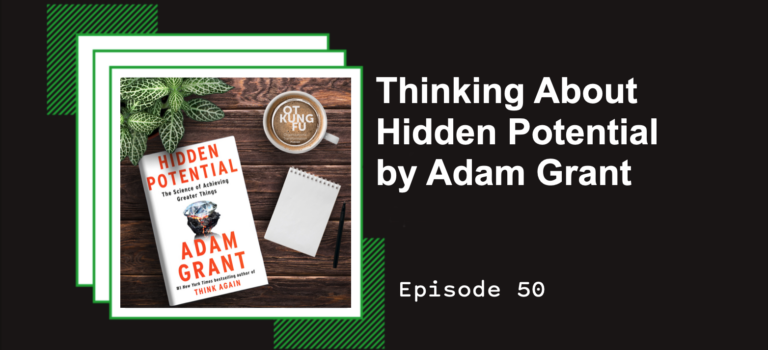
Episode 50 – Thinking About Hidden Potential by Adam Grant

Episode 50 – Thinking About Hidden Potential by Adam Grant

It’s OT Kung Fu’s 50th episode!
We have another book review episode, this week featuring Hidden Potential by Adam Grant! Join Jen and Sandi while they cover topics like:

-Performance Reviews and how they have changed from potential to goal-oriented
-How imperfect leaders are more beneficial than “perfect” leaders
-How meeting folks where there are at instead of where you want them to be cultivates a better workplace culture
-High potential compared to related experience
-Why learning agility is more valuable as a leadership predictor
-Why self-reflection is such an important tool
-Learning curves and useful uncomfortability
-Imposter Syndrome and feedback
-Self-awareness and how it echoes into other aspects of life
-How a “scarcity”mindset affects you
-“Learning Organizations” and follow-through
-How tech and instant delivery plays in

You can check you more about Adam Grant book and take the assessment on his page at adamgrant.net!

Thank you so much for listening! Make sure to check out the video cast under the “Videos” tab!
Connect with Jen on LinkedIn and visit her website Own Up!®
Connect with Sandi on LinkedIn and visit her website Satori Consulting, Inc!

Have a comment, question, or topic for Sandi and Jen? Leave us a comment on LinkedIn! 

Episode 49 – Leadership and Building Organizational Capacity with Todd Conklin

Episode 49 – Leadership and Building Organizational Capacity with Todd Conklin

You made it to the end of July, and we have a new episode of OT Kung Fu for you to celebrate and gear up before a new month begins tomorrow!

Jen and Sandi are joined on this episode by Dr. Todd Conklin, author of Pre-Accident Investigations: An Introduction to Organizational Safety  as well as host of his organizational safety podcast of the same name. From his website:
     “Todd Conklin spent 25 years at Los Alamos National Laboratory as a Senior Advisor for Organizational and Safety Culture.  Los Alamos National Laboratory is one of the world’s foremost research and development laboratories; Dr. Conklin has been working on the Human Performance program for the last 15 years of his 25-year career.  It is in this fortunate position where he enjoys the best of both the academic world and the world of safety in practice.  

        Conklin holds a Ph.D. in organizational behavior from the University of New Mexico.  He speaks all over the world to executives, groups and work teams who are interested in better understanding the relationship between the workers in the field and the organization’s systems, processes, and programs.  He has brought these systems to major corporations around the world.  Conklin practices these ideas not only in his own workplace, but also in the event investigations at other workplaces around the world.  Conklin’s best selling book, Pre-Accident Investigations: An introduction to Organizational Safety is a best selling book on safety.  Conklin has several other books and a huge podcast following for his twice-weekly podcast of the same name.  Conklin defines safety at his workplace like this:  ‘Safety is the ability for workers to be able to do work in a varying and unpredictable world.'”

Listen along as they talk about the 5 HOP principles mentioned in Dr.Conklin’s book and how leadership mindsets can flourish within those principles, what simply having confidence can do for you, “why?” versus “how?” and what kind of leader flocks to each question, and more! Thank you so much for joining us on this episode, Dr. Conklin!

You can find all of Dr. Conklin’s books and his podcast on his page on HOP Hub here.
Dr. Conklin and Jen will be speaking at the next Conklin Conference in Santa Fe, NM from September 10th-September 12th 2024. You can sign up for the conference HERE.

Thank you so much for listening! Make sure to check out the video cast under the “Videos” tab!
Connect with Jen on LinkedIn and visit her website Own Up!®
Connect with Sandi on LinkedIn and visit her website Satori Consulting, Inc!

Have a comment, question, or topic for Sandi and Jen? Leave us a comment on LinkedIn! 

Episode 48 – Influence as a Strategy: Getting Better Outcomes with Others

Episode 48 – Influence as a Strategy: Getting Better Outcomes with Others

Happy Summer! Beat the heat with Sandi and Jen and listen along as they tackle the topic of influence (as a person, not for social media)! Today they cover:

  • -How reciprocity is different within the workplace
  • -How you show up as a leader to your peers vs. to your boss
  • -The traits of a successful workplace influencer
  • -Their love and use of the EverythingDiSC® by Wiley within training they have done
  • -Negotiation awareness and the balance required to not cross the line into -manipulation
  • -Persuasion vs. Influence

and more! 

Thank you so much for listening! Make sure to check out the video cast under the “Videos” tab!
Connect with Jen on LinkedIn
Connect with Sandi on LinkedIn

Have a comment, question, or topic for Sandi and Jen? Leave us a comment on LinkedIn!

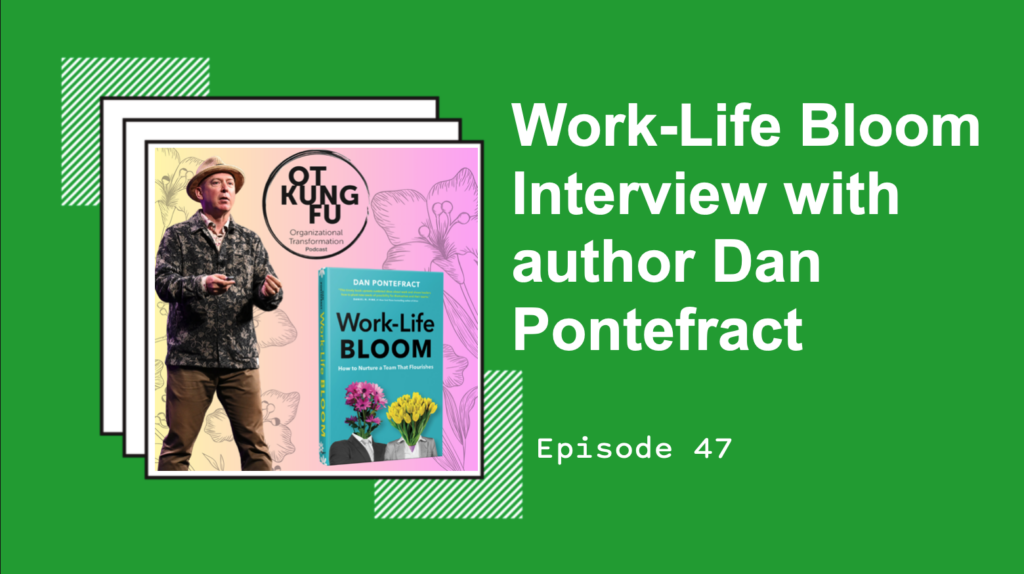
Episode 47 – Work-Life Bloom Interview with author Dan Pontefract

Episode 47 – Work-Life Bloom Interview with author Dan Pontefract

We have a real treat for listeners today! Jen and Sandi are joined by award-winning author Dan Pontefract to talk about his new book Work-Life Bloom: How to Nurture a Team that Flourishes! From his website: “Dan is a renowned keynote speaker who has presented at four TED events and delivers approximately 50 keynotes annually. He is an adjunct professor at the University of Victoria’s Gustavson School of Business and has received over 25 industry, individual, and book awards.” Listen along as Dan, Sandi, and Jen cover topics such as:

  • -The origin of Work-Life Bloom
  • -Personas in Work/Life Balance
  • -“Soil” vs “Water” tests in the workplace
  • -Workplace Vulnerability and Gen Z

You can connect with Dan on his website donpontefract.com, and you can check out the book’s page at worklifebloom.com
Dan’s Assessment: worklifebloom.com/work-life-assessment
Connect with Dan on LinkedIn!

Thank you so much for listening! Make sure to check out the video cast under the “Videos” tab!
Connect with Jen on LinkedIn
Connect with Sandi on LinkedIn

Have a comment, question, or topic for Sandi and Jen? Leave us a comment on LinkedIn!

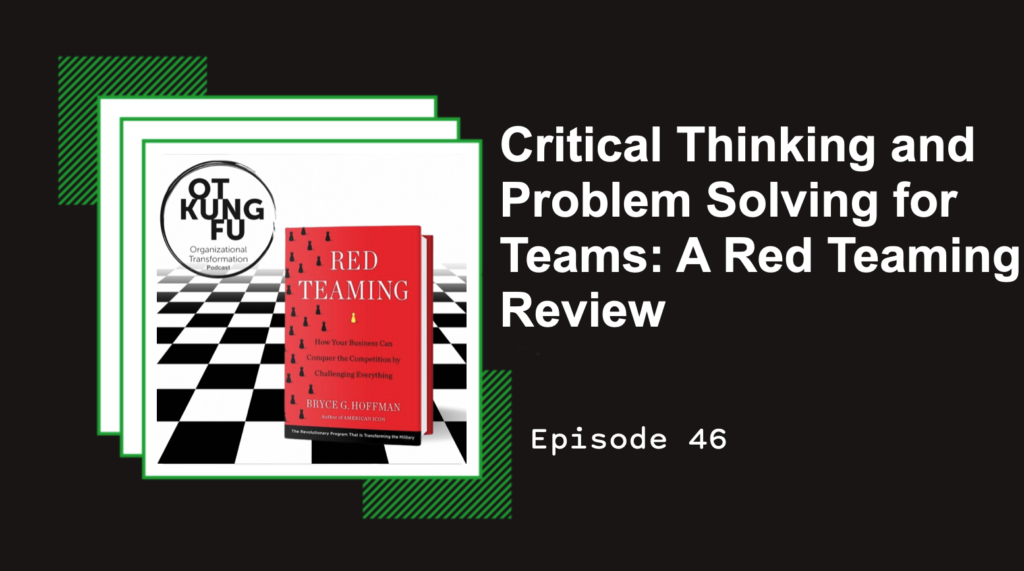
Episode 46 – Critical Thinking and Problem Solving for Teams: A Red Teaming Review

Episode 46 – Critical Thinking and Problem Solving for Teams: A Red Teaming Review

Welcome back to OT Book Club, er, we mean OT Kung Fu! Jen and Sandi invite you to listen in as they discuss “Red Teaming: How Your Business Can Conquer the Competition by Challenging Everything” by Bryce G. Hoffman.

Enjoy the ASMR of Jen and Sandi flipping through to their favorite parts and points of the book and how you can empower your teams to think critically in tough situations, and how you can get that critical thinking to produce critical solutions! If you want Jen and Sandi to review more books/literature about teams or accountability in the future, let us know!

Thank you so much for listening! Make sure to check out the video cast under the “Videos” tab!
Connect with Jen on LinkedIn
Connect with Sandi on LinkedIn

Have a comment, question, or topic for Sandi and Jen? Leave us a comment on LinkedIn!

Episode 45 – The Customer Experience and a Coaching Approach with Dan Coldwell

Episode 45 – The Customer Experience and a Coaching Approach with Dan Coldwell

Here to tell you not to live in fear of bad reviews, Jen and Sandi are joined by Dan Coldwell this week, a colleague of Sandi’s at Satori Consulting, Inc. Dan has 30 years of experience in financial services as an executive and industry speaker and has also served as chief marketing and chief operations officer in past positions. He is a hockey certified coach, and he “cross-pollinates” (as he puts it) between the business and sports world.

Listen along as they chat about:

  • -acting on feedback/pain points
  • -the 3 steps of responding to feedback
  • -Feedback collection Do’s and Don’ts
  • -how to not fear bad reviews because of what they do for good reviews

Thank you so much for joining Jen and Sandi, Dan! If you’d like to chat more with Dan about the customer experience, you can contact him through the Satori Consulting, Inc. site.

Thank you so much for listening! Make sure to check out the video cast under the “Videos” tab!
Connect with Jen on LinkedIn
Connect with Sandi on LinkedIn

Have a comment, question, or topic for Sandi and Jen? Leave us a comment on LinkedIn!

Episode 44 – Transformational Leadership with Cara Cameron

Episode 44 – Transformational Leadership with Cara Cameron

Happy first podcast of 2024! We’re starting out this new year with a treat for you- Jen and Sandi are joined by Sandi’s colleague Cara Cameron, who holds the position of Chief Future of Work for Mutual Insurance. She has worked in Human Resources for over 15 years and is passionate about developing leaders. With her Chief Future of Work position, she is able to better analyze how the changing workforce impacts the organization, teams, and how those parties respond to the change. Listen along as Jen, Sandi, and Cara talk about:

  • -How do employees want to work/what they are looking for from a Chief Future of Work
  • -how the position develops and implements plans around intention and how HR supports those intentions
  • -how they meet skepticism and the “I’ll believe it when I see it” attitude
  • -how supportive CEOs/Presidents/Leadership are the keys to enacting positive change
  • -what it means when you understand where your team is through touch points and intentional support
  • -that Performance Management is an ongoing process

Thank you so much for listening! Make sure to check out the video cast under the “Videos” tab!
Connect with Jen on LinkedIn
Connect with Sandi on LinkedIn

Have a comment, question, or topic for Sandi and Jen? Leave us a comment on LinkedIn!

Episode 43 – Change Starts with You

Episode 43 – Change Starts with You

Surprise! One additional episode before the New Year! This week, Jen and Sandi discuss changes in the workplace and how those changes come about. It all starts from the same place: you! Join them as they cover:

  • -how change is not linear, but dynamic
  • -how to go about thinking about change and understanding the “why” of change
  • -how changing requires vulnerability
  • -the Pyramid of Readiness model by Cy Wakeman
  • -the level of awareness in change
  • -self-reflection when it comes to change

and more!

Enjoy this last episode of 2023, and Jen and Sandi will see you in 2024!

Check out the Video cast under the “Video” tab!
Connect with Jen on LinkedIn
Connect with Sandi on LinkedIn

Have a comment, question, or topic for Sandi and Jen? Leave us a comment on LinkedIn!

Episode 42 – Leveraging Mastermind Groups to Grow Yourself and Your Business with Julie Ellis

Episode 42 – Leveraging Mastermind Groups to Grow Yourself and Your Business with Julie Ellis

Happy December! This week, Jen and Sandi are joined by fellow entrepreneur and author Julie Ellis! Join the trio as they discuss:

  • -Julie’s start with Mabel’s Labels and how she scales her leadership systems for different sized teams at different revenue numbers
  • – Julie’s new Mastermind project: a peer-reviewed mentorship for women in business and how to scale your successes
  • -What evolutions take place as your business grows in sales and in people and the leadership needs that come from that
  • – Julie’s Book Big Gorgeous Goals:How Bold Women Achieve Great Things

Thank you so much for joining us, Julie! If you have a question for Jen, Sandi, or Julie, leave a comment below or connect with them on LinkedIn!

You can find Julie by clicking the following:

Julie’s Linktree
Julie’s Website
Julie’s LinkedIn
Buy Julie’s Book

Check out the Video cast under the “Video” tab!
Connect with Jen on LinkedIn
Connect with Sandi on LinkedIn

Have a comment, question, or topic for Sandi and Jen? Leave us a comment!

Episode 41 – Strong Leaders Know They Are Imperfect

Episode 41 – Strong Leaders Know They Are Imperfect

In this episode of OT Kung Fu, join Jen and Sandi as they dive into how strong leaders are able to recognize their own shortcomings to encourage their own growth and stability as leaders. Topics in this episode include:

– self reflection and the act of identifying your own insecurities and how that is a helpful skill

-Imposter syndrome

-The Johari Window

-Humility and learning from mistakes

-How being vulnerable is vital to learning

-Adaptability and Inclusivity within that self-reflection

Check out the Video cast under the “Video” tab!


Connect with Jen on LinkedIn

Connect with Sandi on LinkedIn

Have a comment, question, or topic for Sandi and Jen? Leave us a comment!

Episode 40 – Leadership Training at the Top

Episode 40 – Leadership Training at the Top

Join Jen and Sandi LIVE from New York (not on Saturday Night, unfortunately) as they discuss how often the teams at the top and how the top team can be skipped when they start investing in team learning and workplace learning. They touch on the importance of top teams always checking in with their own learning as organizational health can shift and grow.

Editor’s note: due the location and way of recording, there is a door noise at the 11:10 mark. Removing this would also remove the voice audio, so we were only able to dampen it. Jen is also wearing jewelry that clicks when moved, and we could not could not separate out without deleting voice lines as well. We apologize if these are distracting.

Have a comment, question, or topic for Sandi and Jen? Leave us a comment in the box below!

Episode 39 – Psychological Safety and Accountability

Episode 39 – Psychological Safety and Accountability

Sandi and Jen explore the topic of what it means when someone feels psychologically safe in a workplace and where that starts for us, and what affect that can have on workplace accountability.

Have a comment, question, or topic for Sandi and Jen? Leave us a comment in the box below!

Success Tips from a Virtual Teaming Expert

Remote Teams: Success Tips from a Virtual Teaming Expert

Organizational change takes time to complete and even more time to master. It takes patience for the changes to take root. Now that teams work from home, and leaders are managing remote teams, there are new challenges causing the implementation of changes to be even more difficult. There are, however, a few things that organizations can do to make that change happen, as we’ve all become virtual team members in a very short period of time.

Trina Hoefling is an organizational development and transformational change consultant. She’s a graduate school professor, master teacher, strategic facilitator, leadership coach, and virtual team collaboration expert. She’s also the author of a book called Working Virtually, Transforming the Mobile Workplace and a contributing writer for The Handbook of High-Performance Virtual Teams

OT KungFu was grateful to learn more from her expertise about virtual team building, managing remote teams, and everything a leader should know about teamwork from home.

Remote Workforces and Virtual Teams

Is there a difference between these terms? 

There are certain terms you can use interchangeably: virtual worker, virtual team member, remote worker, all of those are interchangeable in day-to-day life. For our use, however, there is a difference between a virtual worker and a virtual team member

Do those employees who work from home need to depend on each other to get the job done? Are they coworkers who are in an independent team, like in a call center environment? Or are they team members that need to work together to deliver their final product or service to their customer? 

There are some things you need to know to engage the worker rather than the team member. Businesses treat every employee as a team member, whether they have to engage with others to get the work done or not because it’s collaborative. 

But, the truth of the matter is, when we’re moved suddenly to a virtual environment, we have to ask ourselves two questions: 

1) How much do the team members need to work together to get the job done and 

2) How much is the virtual manager the conduit of the work?

Leaders and Remote Teams

A good team leader is always the most powerful piece, but when managing remote teams, they become even more important.

 The virtual managers are the cream of the Oreo cookie. No matter what, they’re the primary connector of the workforce to the organization. Whether your manager is your primary contact or not, when you move to a virtual work environment, especially suddenly, that manager is your major connection with the organization, your major purpose giver, and your major contact.

It doesn’t remain that way, but at first, as people are trying to figure this out, that manager is a critical person in determining whether or not the employee can succeed. The virtual manager is the key influencer of work satisfaction and employee retention.

You take people away from their teammates, and they’re suddenly looking at their own four walls and wondering what signals they need to pay attention to and what’s most important. They need that manager to bring people together and recreate that connection to the workplace.

So what advice is there for a manager who’s just been thrust into this new virtual work environment, especially if they’ve never done it before? 

How do they hold people accountable?

How do they manage results? 

What do they need to do differently? 

 How do they know the team is really working?

First of all, the data suggests your team is working even harder because you don’t have those built-in stops and breaks. For a healthy, efficient team, the transition from team office work to teamwork from home is as simple as adding the word “virtual” to whatever you’re already doing. If you’re managing by results, now you’ll be managing by results virtually. The real question is:

How do you know they’re working now? How do you know they’re getting the job done in a normal office setting? 

Do you have a result and management process in place? Do you have a performance evaluation system? Do you do coaching sessions? How do you observe behavior? 

In short: What do you do now? 

If you’re managing by sight alone, you’re not managing. Whatever you sucked at before your team moved into a virtual space, you’re really going to suck at it now. If you didn’t know how to really manage your team before, it’s going to be even more difficult now.

It all comes down to communication skills, and if everyone is out-of-sight, and you have no idea how to manage or communicate with others when they’re out-of-sight, then that’s where you have to start.

Pick up the phone, have a conversation, get an understanding of what’s going on, and what you’ll find is, as time goes on, fewer phone calls will be needed. But, if you’re starting from the ground up, it’s going to depend on how often and frequently you’re contacting people to really find out where things are. If the correct systems of communication aren’t already in place, you’ll have to create them. Watch for areas where the disconnects are happening that may not have shown up before.

If you feel like somebody is not doing their job, or that a coworker’s not working as much, if there’s a system in place where the leader is regularly touching base with the team, and genuinely wants to connect, those issues will take on a completely different tone. 

The Top Skills of a Successful Virtual Leader 

First, good communication skills: written and oral are imperative. You don’t have to be an extrovert to be a good virtual manager. That’s a myth that we should dispel right now. You do have to care about your team members and be willing to reach out to them, but not as “big brother, big sister” oversight. What’s needed is the human-to-human connection. Authentic care about your team, communicated through the time and attention you dedicate to intentional, relational communication.

Those are the big things: interpersonal skills and caring. The other one is being clear, and helping the team be clear with each other so that you can start establishing trust in this new world. A good leader that is trusted can help a team accomplish that better and faster, rather than a leader that is hands-off and disconnected from the team.

The Needs of a Virtual Team

What about the virtual worker? What are they experiencing coming into this? Panic, fear, and isolation. 

Obviously, as a manager, there’s only so much you can do, but as far as work goes, some people are more comfortable using digital tools than others. Assuming that some of the team is not as comfortable, we still all have to use these tools, share information properly, and get on video conferencing once in a while. 

So how do we make this part of life separate from panic, fear, and isolation?

Workers and virtual professionals can get some fun-time learning to use the tools: doing a collaborative brainstorm on a whiteboard, some light-hearted practice playing with annotations, and other forms of opportunities. Allowing them to be a learning professional who is in transition, and communicating that the expectations have shifted, will simplify things and get people’s confidence and comfort up, so they can go back to focusing on the work they’re there to do, instead of how they’re having to do it. Virtual team building doesn’t have to be completely separate from practical work or run by an external team for a one-time experience.

Teaching and training team members together as a group is also important. Let’s do some fun things, let’s make some mistakes together, share part of this transition as a team, so that we avoid the panic and isolation that might set-in if you’re forced to go through this process without sharing the experience with others.

No matter who you are, mistakes will be made. There will be miscommunications. Just plan on them, and make an agreement to assume positive intent and talk about it. The little frustrations can really collect and show up in a virtual environment. You can hide it from each other, but you’re still steaming inside.

Creativity and breaking up the day-to-day can reveal really great information on the status of your team. A mix of virtual team-building activities that range from practical to relaxing or stress-relieving is vital to managing remote teams well. Virtual happy hours, free online webinars using Zoom, letting somebody else teach the whole team together, are just a few examples. 

Through these experiments, you can find the invisible threads that are connecting the individuals on your team. If that thread is M&M’s, start mailing out packets of hard boxed M&M’s to all the team members.

Be creative and fun, and realize that even in a non-crisis environment, when you are virtual, you need to make time to have some fun together, whether it’s a virtual pizza party or a virtual office tour.

But these are the extra pieces. What is the foundation of a high-performance virtual team?

3-Step Process for High-Performance Virtual Teams

The first step is simple. Develop your team

Identifying who’s going to be on your team, helping them get to know each other, creating the right dynamic between team-members through virtual team-building opportunities, and negotiating agreements. 

The second step is to support your team. This is a shared responsibility with the manager and the team members. Team care, clear flow of communication, and project scope have to be done together. Managing a remote team doesn’t mean the leader has to drown themselves in responsibility. The problem isn’t that we’re asking too much from our team members who work from home, it’s that maybe we’re not using their energy, gifts, and talents properly.

One of the most disappointing findings right now is that before the crisis, 70% of virtual team members reported they felt they were not trusted, and that they were left out of critical communications which impacted their ability to do their job. 

That’s high. 

Distance and Unconscious Bias

We could go on and on about distance and unconscious bias, but we’ll cover it quickly. 

We think like cavemen. We’re creatures of habit and we tend to trust the people we see right next to us, or at least we pay more attention to them. In our unconscious mind, we believe that somebody far away can’t be as dangerous or as helpful, because they’re not there. It’s inaccurate in today’s world, but our brain still works the same way.

This is an opportunity to get into better habits: be more intentionally inclusive, right? Nothing like a good crisis to help you grow your leadership skills!

Likewise, the team members have the responsibility to speak up and ask. It’s not all on the manager. The best way to keep each other engaged, informed, and supported is by delivering results. We all want to be part of a successful team, and if we deliver results, then we can learn to work together. 

For more great resources on teamwork from home, managing remote teams, or virtual team building, check out the combined brainpower of Jennifer Long and Sandi Verrecchia on the OT KungFU podcast, or learn more about their individual work through Management Possible and  Satori Consulting Inc.

Jen is the owner of Management Possible® focused on training and coaching multi-level management and leadership individuals and teams nationally and globally. Sandi is the owner of Satori®  Consulting inc. a global consulting firm focused on helping organizations solve complex problems in strategy, leadership and governance.
The Hybrid Workplace Challenge

Strategy and Decision-Making

What does going back to work look like? What is a hybrid workplace, at its core? What does all of this mean for leaders? What do we have to do differently? 

These are the top questions we address in today’s episode of The OT Kung Fu Podcast.

This is the time to get rid of the policies that don’t work and the systems that are no longer serving the team. Question everything before reopening, or introducing big changes like a hybrid workplace.

There’s no going back to normal. You’re never going back to the same thing. It’s not going to be the same because no one is the same. We are all thinking differently about work. We are all feeling differently about what’s important. Just by virtue of changing as people, how we think about work, what work needs to be for us, and what’s going to create meaning for you, has shifted. Just because you’re returning to a building, doesn’t mean the job, or the environment, will be the same.

There’s a big balancing act between the short-term and the long-term when it comes to leading and decision making. What are the short-term decisions that have to be made? What are the long-term decisions that have to be made? Do they conflict? Will they be too much to handle at once? How do they relate to one another?

Reshaping Your Organization

The changes that have occured in the last few years have been a challenge, but they have also created  an opportunity for companies to rethink how they want to structure their culture. It’s an opportunity that most leaders never get: the chance to restart, a totally clean slate. The things that we previously held as gospel truth have now been proven incomplete, and companies must respond in a fearless, open-minded way.

Communication and Leadership

These two come hand-in-hand when it comes to successful restructuring. Making changes, while necessary, can be incredibly difficult without support and unity, both within leadership and the team as a whole.

What is most important to your employees? What has their experience as a team member in the last couple years taught them? 

How are you starting the dialogue and conducting the conversation? Are you just sitting in a room of leaders making decisions on your own? This might have been necessary as teams and companies had to simplify to survive, but for growth, you need as much information as possible.

Moving out of Crisis Management

Next, it’s time to move on from the strategies that worked when you were in crisis-mode. 

For a while now, the norm has been a group of four or five people making the decision for the whole organization, without engaging with the rest of the team. While this is helpful to keep things moving in complicated times, this tendency isn’t good for the long-run. 

Many leaders were so focused on pushing through, and were often so desperate to keep their organization alive, they’ve now continued to use the same strategies. 

As companies are focusing on transitioning out of this phase, they are tapping into their workers, doing a lot of tiny pulsing and surveying, and are investing in their employees as people.

Before, leaders simply told them what to do, but now the principle of leading with empathy is considered a necessary and important piece of success.

Essential Skills

Empathy is a great example of the shifting values and essential skills in the workplace. 

Across the board, flexibility has been identified as the number one skill for effective leading.

Especially in the United States, there’s this idea that, when it comes to empathy, wellbeing, health, and problems in general, “there’s a department for that”. It’s not necessary to make it a priority, and the leaders certainly don’t want to “waste their time” talking about things that aren’t directly business-related. 

The conversation really starts there: how do you really allow people to be forthcoming?

Things that would have been the typical water cooler talk back in the office are even more underground because it’s an online chat now, or a text between coworkers, sharing their discomfort with returning to the office.

From a manager’s perspective, the training that is needed is on flexibility and empathy.

Addressing Burnout

In Jen and Sandi’s experience, 100% of people they’ve talked to have experienced burnout.

People feel exhausted, overworked, overwhelmed, even to the point of hopelessness. Burnout, naturally, leads to a series of questions:

Can I keep going like this?

Do I want to?

Burnout is a huge thing, and utilizing a hybrid workspace hasn’t been the solution to that problem.

In fact, all of the over-communicating, the distractions, all of the ways life begins to blur into your workspace, the disconnectedness, the isolation, and even the apathy that can grow over months all adds fuel to the fire, leading you closer to complete burnout.

You’re pushing outside your own comfort zone. You don’t feel like you’ve mastered anything, and you’re not sure what’s permanent and what’s temporary.

While there’s only so much that can be done to help, there are practical ways for leadership to invest in their team members to lend support and prevent burnout. 

When it comes to maintaining those work/life boundaries, having a designated home office space is incredibly important. Unfortunately many people are still working from the kitchen table, in crappy chairs. 

The goal is to avoid death by a thousand paper cuts. 

It’s all the little small things that pile on top of each other that leads to burnout, when a small gesture of empathy can relieve the burden.

Going Forward with a Hybrid Workplace

Even in the hybrid workplace, new cultural norms are being built up. Right now, individuals, teams, and leaders are both actively and passively deciding what is now acceptable and what’s not. 

Is helping your kids in the middle of the day an acceptable thing in your work environment? Maybe, maybe not. They probably won’t be using online school anymore, but they may still have toddlers at home because daycare isn’t an option anymore. 

All of these pieces need to be considered when deciding what works for your organization. You can put together what you think is a good, meaningful, purposeful strategy for their organization and yet still lose some critical talent because they want to work on-site 100% of the time, or because they feel too insecure with the technology when it comes to working remotely.

Sandi and Jen believe there’s going to be a huge shift or upheaval of key talent, unless you can master your strategy. As a whole, this process is a test of test of your values.

You have to ask yourself, your leaders, and your employees what is really important. There’s been a change in what we see as doable, which impacts what is actually doable. People have taken stock of what is truly important to them, organized their priorities, and values, and they’re able to stand in them a little bit more than before. 

The question is, will workplaces respect their newfound priorities, and empower them?

Short-Term vs. Long-Term

In general, the best thing you can do is encourage the heart. The whole practice of supporting people, developing their skills, and creating meaning with them in the organization requires critical conversations. 

You need to balance the ability to make the best short-term decisions while maintaining the best long-term vision you can.

There are very few people, very few leaders, who are actually skilled in this way innately. Training these principles should be commonplace, rather than a last resort. 

When shit hits the fan two years from now, or whenever the inevitable issue arises, will your leaders and employees have the skills and tools they need? Will they be able to hit the ground running?

Regardless of what stage your business is at, building and maintaining your team is the key to short-term and long-term success. There needs to be a creative, open, flexible environment where no one is getting judged for their differences in perspective, opinions, needs, or skills. 

You have to create an environment that will utilize opportunities to reshape the hybrid workplace culture into something empowering, something your team can believe in and dedicate themselves to.

For more resources like this, head over to OT KungFu’s website for podcasts, blogs, and more. To find more about Sandi and Jen, you can find them on their respective sites: Satori Consulting, and Management Possible.

Jen is the owner of Management Possible® focused on training and coaching multi-level management and leadership individuals and teams nationally and globally. Sandi is the owner of Satori®  Consulting inc. a global consulting firm focused on helping organizations solve complex problems in strategy, leadership and governance.
Episode 13 – Upskilling Your Team

Episode 13 – Upskilling Your Team

With rapid change comes the need for new skills as well as updated skills. This podcast covers some thinking and strategies around the need for on-going skills development, some solutions on how to incorporate skills development as managers and leaders as well as some of the most critical skills people need regardless of role and experience.
Episode 11 – Tips from a Virtual Teaming Expert

Episode 11 – Tips from a Virtual Teaming Expert

Sandi and Jen welcome special guest Trina Hoefling. Trina is an expert in Virtual Teaming.  Jen, Sandi and Trina discuss working as a virtual team and many of the issues that crop up and how to solve them.
Trina is the author of the book Working Virtually: Transforming the Mobile Workplace  and you can get more information and help at Trina’s website  thesmartworkplace.com